Customer expectations have changed. People want quick answers, accurate product information, and assistance whenever they contact a business. For businesses operating through Facebook, Instagram, and WhatsApp, meeting these expectations requires time, people, and money. This is where Meta Business Agent enters the picture.
Meta Business Agent introduces AI-powered customer communication that helps businesses answer questions, recommend products, qualify leads, and support sales. It aims to reduce repetitive work while helping businesses maintain customer relationships around the clock.
For Bangladesh, this development deserves attention. Thousands of businesses depend on Facebook pages, Messenger conversations, and WhatsApp to communicate with customers. Many small businesses struggle to manage hundreds of messages while handling orders, marketing, and daily operations.
As a professional digital marketer who has deployed and tested Meta Business Agent at SecondBit, I see this technology as more than another chatbot. It represents a significant change in how businesses manage customer communication.
In this article, I will explain how Meta Business Agent works, how it saves time and money, and what its arrival means for businesses and employees in Bangladesh.
What Is Meta Business Agent?
Meta Business Agent is an AI-powered business assistant developed by Meta. It helps businesses manage customer conversations through Meta’s messaging platforms.
Unlike traditional automated replies, it uses artificial intelligence to understand customer questions and provide relevant answers based on business information.
According to Meta’s June 3, 2026 announcement, Business Agent supports several business activities:
- Answering customer questions about products, prices, and services.
- Recommending products from business catalogs.
- Qualifying potential customers and capturing leads.
- Booking appointments.
- Supporting sales conversations.
- Transferring conversations to human employees when necessary.
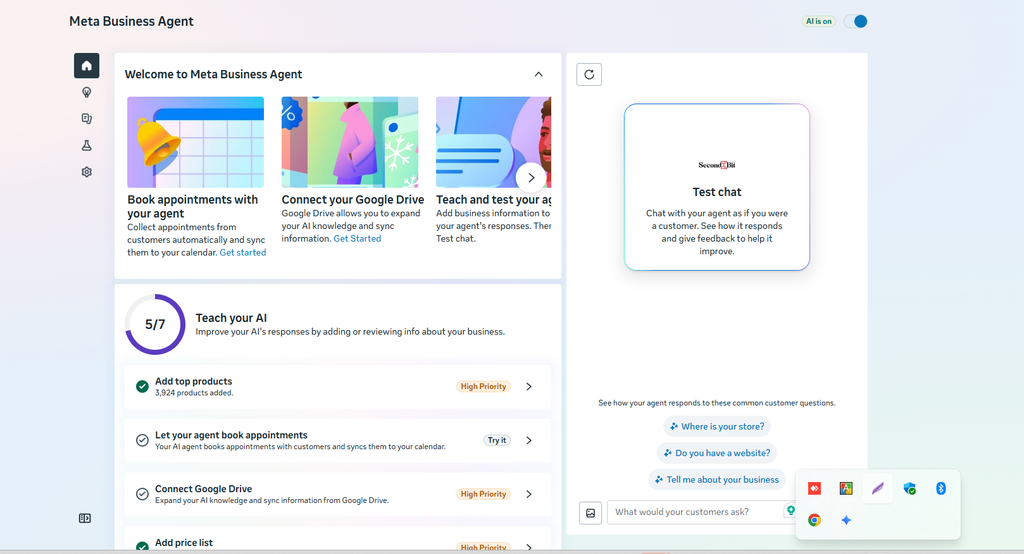
Meta also introduced the Meta Business Agent Platform. This provides businesses with tools and integrations to build more customized AI agents connected to systems such as Shopify and Zendesk.
The main difference is that a traditional chatbot follows predefined conversation flows, while an AI agent understands context and responds according to the information and instructions available to it.
You can explore the official product information at Meta Business Agent.
How Does Meta Business Agent Work?
Meta Business Agent uses artificial intelligence to understand customer messages and generate business-specific responses.
Its effectiveness depends on the information, instructions, integrations, and permissions available to the agent.
Here is how the process works.
1. Business Information and Knowledge
The business provides relevant information about its products, services, policies, and operations.
This information helps the agent understand what the business offers and how it should communicate with customers.
For an e-commerce store, useful information includes:
- Product names and descriptions.
- Prices and availability.
- Delivery policies.
- Payment methods.
- Return and exchange policies.
- Customer support instructions.
2. Understanding Customer Messages
When a customer sends a message, the AI processes the question and identifies what the customer wants.
For example, a customer might ask:
“Do you have Seiko SRPD59 in stock?”
The agent needs to understand that the customer is asking about a particular watch model and its availability.
3. Generating Relevant Responses
The agent uses available business information to answer the question.
If the exact model is unavailable, it should communicate that clearly rather than inventing product availability.
It might also recommend similar products when the business has provided relevant catalog information.
4. Supporting the Customer Journey
The agent handles repetitive enquiries and guides customers through different stages of the buying process.
These include product discovery, payment information, delivery questions, and order enquiries.
5. Human Handoff
Some conversations require human judgment.
Customers might raise complaints, request special arrangements or ask questions that require additional verification.
Meta Business Agent supports human intervention so businesses retain control over important customer interactions.
Meta Business Agent vs Traditional Chatbots
Traditional chatbots usually depend on predefined keywords, menus, and decision trees.
For example, a customer types “Delivery”, and the chatbot displays a delivery policy.
An AI-powered business agent approaches the same interaction differently. It understands the customer’s question and generates a relevant response using available business information.
The key differences include:
| Feature | Traditional Chatbot | Meta Business Agent |
| Responses | Predefined flows | AI-generated responses |
| Context | Limited | Context-aware |
| Product recommendations | Rule-based | AI-supported |
| Customer questions | Often keyword-dependent | Natural language |
| Business information | Manually configured flows | Business knowledge |
| Human support | Depends on setup | Human handoff support |
This does not mean every AI agent will outperform every traditional chatbot. Performance depends on data quality, configuration, and the complexity of customer requests.
How Meta Business Agent Saves Businesses Time and Money
One of the biggest advantages of AI business automation is reducing repetitive manual work.
Consider an e-commerce business receiving 200 messages every day.
Customers might repeatedly ask:
- What is the product price?
- Is this model available?
- How much is delivery?
- Do you offer Cash on Delivery?
- Which payment methods do you accept?
- How long does delivery take?
A customer support employee might spend several hours answering these questions.
An AI agent handles many routine enquiries automatically.
1. Reduced Customer Support Workload
Businesses do not need employees to answer every basic question manually.
The agent handles common enquiries, allowing employees to focus on complaints, complex requests, and customer relationships.
2. 24/7 Customer Communication
Customers often send messages outside regular business hours.
Without automation, businesses must wait until an employee becomes available.
An AI agent provides continuous customer communication, subject to its availability, configuration and supported channels.
3. Better Lead Management
A potential customer might enquire about a product but leave without completing a purchase.
An AI agent helps qualify leads, collect relevant information, and guide interested customers towards the next step.
This reduces the risk of losing potential customers because nobody responded in time.
4. Lower Operational Costs
Hiring additional customer support employees increases salary, training, and management expenses.
AI automation reduces the amount of repetitive work assigned to employees.
Businesses might therefore manage higher message volumes without increasing their support team at the same rate.
Actual savings depend on subscription charges, implementation costs, message volume, and human support requirements.
5. Better Conversion Opportunities
Fast and relevant responses reduce friction during the buying process.
When customers receive accurate product information and clear payment instructions, they have a better experience.
In my experience testing Meta Business Agent at SecondBit, I have observed reduced workload and improved conversion opportunities. I consider this one of its most useful business applications.
How Meta Business Agent Can Transform Ecommerce Businesses in Bangladesh
Bangladesh has a large social media audience.
According to DataReportal’s Digital 2026 Bangladesh report, the country had approximately 82.8 million internet users and 64 million social media user identities in October 2025. Meta’s advertising resources also indicated a potential Facebook advertising audience of 64 million.
These figures demonstrate why social commerce matters to Bangladeshi businesses.
Many entrepreneurs operate through Facebook pages, Instagram accounts, and messaging platforms rather than relying entirely on traditional e-commerce websites.
Meta Business Agent introduces several opportunities for these businesses.
Small Businesses and Facebook-Based Sellers
Small businesses often operate with limited employees.
A clothing seller, cosmetics retailer or electronics shop might receive dozens of product enquiries every day.
An AI agent helps answer common questions about prices, sizes, colours, availability and delivery.
This gives small businesses more time to manage inventory, marketing and fulfilment.
Ecommerce Stores
Established ecommerce businesses deal with more complex customer journeys.
They need to manage product catalogues, payment methods, delivery policies, order status and post-purchase support.
With suitable integrations, AI agents help automate parts of these operations.
Service-Based Businesses
Educational institutions, travel agencies, real estate companies and service providers also receive repetitive enquiries.
An AI agent helps qualify potential customers, collect contact details, and provide service information.
This reduces manual communication and helps businesses manage incoming leads more efficiently.
My Experience: Deploying Meta Business Agent at SecondBit
I manage marketing operations at SecondBit, a watch retailer in Bangladesh. Our business handles customer enquiries about international watch brands, product availability, pricing, payment methods, and delivery.
These conversations require accurate information.
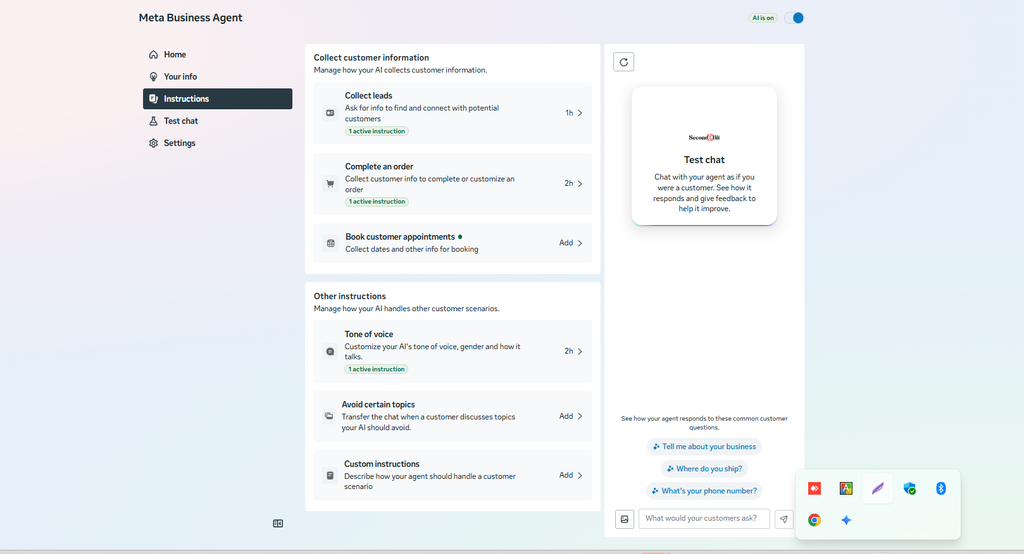
A customer asking about a specific Seiko reference number expects an accurate answer. Someone purchasing an expensive watch also wants clear information about warranty, payment, and delivery.
I deployed and tested Meta Business Agent to support these activities.
I configured its behaviour around several important customer service requirements:
- Product enquiries and product availability.
- Watch model and reference number identification.
- Cash on Delivery conditions.
- Delivery information.
- Advance payment requirements.
- Order confirmation procedures.
For example, our COD policy differs depending on the customer’s location.
Customers in Dhaka do not need to pay an advance for regular COD orders. Customers outside Dhaka need to pay a 10% advance to confirm their orders. Same-day instant delivery requires full advance payment.
The agent needs to communicate these conditions correctly before confirming an order.
This is where proper configuration matters. A generic response is not enough for a business with specific payment and delivery policies.
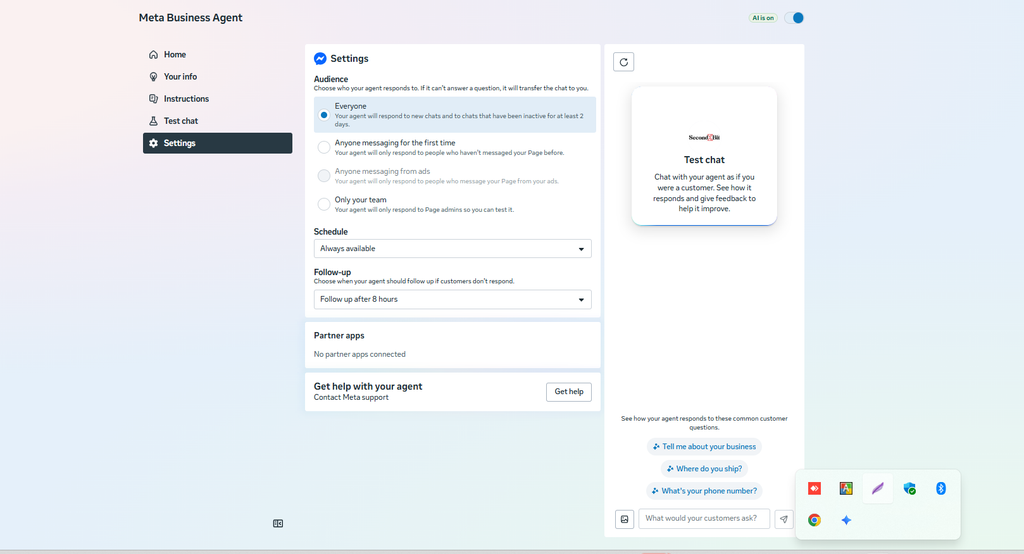
My experience has shown reduced manual workload and improved conversion opportunities. It also highlights an important point: AI automation requires accurate business information and clearly defined instructions.
An AI agent should support business operations, not create confusion for customers.
How Meta Business Agent Will Affect the Bangladesh Job Sector
This is where the discussion becomes more serious.
I believe AI will replace a significant number of entry-level customer support and repetitive digital marketing jobs in Bangladesh.
Many businesses currently employ people to perform tasks that follow predictable patterns.
Examples include:
- Answering repetitive Messenger questions.
- Sharing product prices and availability.
- Providing delivery information.
- Collecting customer details.
- Responding to basic comments.
- Qualifying incoming leads.
- Preparing repetitive marketing responses.
AI agents are increasingly capable of handling these activities.
For businesses, this reduces operational costs. For employees, it creates pressure to develop new skills.
The World Economic Forum’s Future of Jobs Report 2025 identifies AI and information processing technologies as major drivers of workforce transformation. It estimates that these technologies will create 11 million jobs globally while displacing 9 million by 2030.
These are global projections, not Bangladesh-specific employment forecasts. Still, they indicate the scale of change businesses should prepare for.
Which Jobs Face Greater Automation Pressure?
Entry-level positions involving repetitive digital communication face significant pressure.
Some examples include:
- Basic customer support representatives.
- Facebook page inbox operators.
- Entry-level lead generation assistants.
- Repetitive content production roles.
- Basic social media moderation.
- Data entry and administrative support.
This does not mean every employee in these professions will lose their job. Roles involving complex decisions, relationship management, and problem-solving require human involvement.
Which Skills Will Become More Valuable?
The demand for professionals who understand AI-powered business operations will increase.
I believe Bangladeshi professionals should focus on developing these skills:
- AI agent setup and management.
- CRM and customer journey management.
- Marketing automation.
- Performance marketing.
- Data analysis and reporting.
- Conversion rate optimization.
- Strategic content development.
- Customer experience management.
Digital marketers should move beyond simply running advertisements or publishing social media posts.
Understanding how AI, advertising, customer data, and business automation work together will become increasingly important.
Will AI Replace Digital Marketers in Bangladesh?
AI will replace some repetitive digital marketing tasks. It will also change what businesses expect from marketing professionals.
Writing basic captions, generating simple content variations, and responding to common enquiries are increasingly automated activities.
But marketing involves more than producing content.
Businesses still need people who understand:
- Customer behaviour.
- Market research.
- Brand positioning.
- Advertising strategy.
- Budget allocation.
- Conversion tracking.
- Sales performance.
- Business profitability.
An AI agent might respond to a customer, but someone must establish the business strategy, define its objectives, monitor performance, and improve the customer journey.
The digital marketers who learn to manage these systems will have an advantage over those who rely entirely on manual execution.
Challenges and Limitations in Bangladesh
Meta Business Agent presents opportunities, but businesses should understand its limitations.
First, access is not necessarily universal. Meta’s WhatsApp Help Center describes availability as limited to selected countries and businesses. Language support also varies. Businesses in Bangladesh should check their account eligibility and supported languages before planning a full deployment.
Second, AI depends on accurate information. Incorrect product prices, outdated inventory details, or unclear payment policies lead to poor customer experiences.
Third, complex customer complaints still require human support.
Finally, businesses must consider customer privacy, data access, and security when connecting AI agents to their systems.
Automation should follow clear business rules and appropriate access controls.
The Future of AI-Powered Businesses in Bangladesh
Bangladesh has a growing digital economy and a large population of entrepreneurs who depend on online platforms.
AI business agents will make automation more accessible to businesses that previously lacked the budget for dedicated technology teams.
I expect three important developments:
- Small businesses will adopt AI customer support to handle growing message volumes.
- Ecommerce companies will connect AI agents with product catalogues, CRM systems and order management platforms.
- Digital marketing agencies will expand their services into AI automation, customer journey optimization and business process management.
The demand for professionals who understand both marketing and technology will also increase.
Businesses that prepare early will have more time to improve their systems, train employees and build better customer experiences.
Final Thoughts
Meta Business Agent represents an important development in business automation.
For Bangladeshi businesses, its biggest value lies in reducing repetitive work, improving response times, and supporting customer acquisition.
My experience at SecondBit has reinforced my belief that AI agents are becoming practical business tools rather than experimental technology.
But businesses should not treat AI as a replacement for proper management. Accurate information, clear instructions, human supervision, and a well-defined customer service process still matter.
For professionals, the message is equally clear. Repetitive tasks face increasing automation pressure. Learning AI tools, marketing automation, data analysis, and customer experience management is becoming essential.
The future belongs to businesses and professionals who understand how to combine technology with sound business decisions.
Frequently Asked Questions (FAQs)
1. What is Meta Business Agent?
Meta Business Agent is an AI-powered business assistant developed by Meta. It helps businesses answer customer questions, recommend products, qualify leads, and support sales through Meta messaging platforms.
2. Is Meta Business Agent available in Bangladesh?
Availability depends on Meta’s rollout, supported countries, business eligibility, and messaging channel. Bangladeshi businesses should check their Meta Business accounts for access rather than assume universal availability.
3. Is Meta Business Agent free?
Meta initially announced free access to get started, with paid subscription options planned. The Meta Business Agent Platform also has a separate pricing structure. Businesses should check current pricing and eligibility before deployment.
4. How does Meta Business Agent help ecommerce businesses?
It helps ecommerce businesses answer product questions, recommend products, qualify leads, communicate delivery information, and support customer service. More advanced integrations support connections with business systems.
5. Will Meta Business Agent replace customer support, employees?
It will automate many repetitive customer support tasks. Employees who handle complex complaints, customer relationships, and business decisions will still play important roles.
6. What is the difference between Meta Business Agent and a Messenger chatbot?
A traditional Messenger chatbot often relies on predefined menus and response flows. Meta Business Agent uses AI to understand customer questions and generate context-based responses using available business information.
7. Should small businesses in Bangladesh adopt AI customer support?
Small businesses should explore AI customer support when they receive frequent, repetitive enquiries. They should first organize their product information, payment policies, and delivery instructions, then evaluate the available automation options.
8. What skills should digital marketers learn to work with AI agents?
Digital marketers should develop skills in AI automation, CRM management, data analytics, performance marketing, conversion optimization, and customer experience management.