From Missing Purchases to Reliable CAPI: A Deep-Dive Case Study in GA4, Meta CAPI, GTM & Stape

Executive Summary

In September 2026, I identified a conversion-tracking discrepancy on a website where the backend showed more completed paid orders than the analytics and advertising platforms were reporting.

The initial discrepancy was straightforward. Website backend: 3 paid orders, 2 Cash on Delivery, 1 online payment. But GA4 received 2 purchases, and Meta received 2 purchases as well.

The missing conversion was the online-payment order.

At first, this looked like a possible Google Tag Manager trigger problem. However, rather than immediately changing the GTM configuration, I traced the order through the complete measurement architecture:

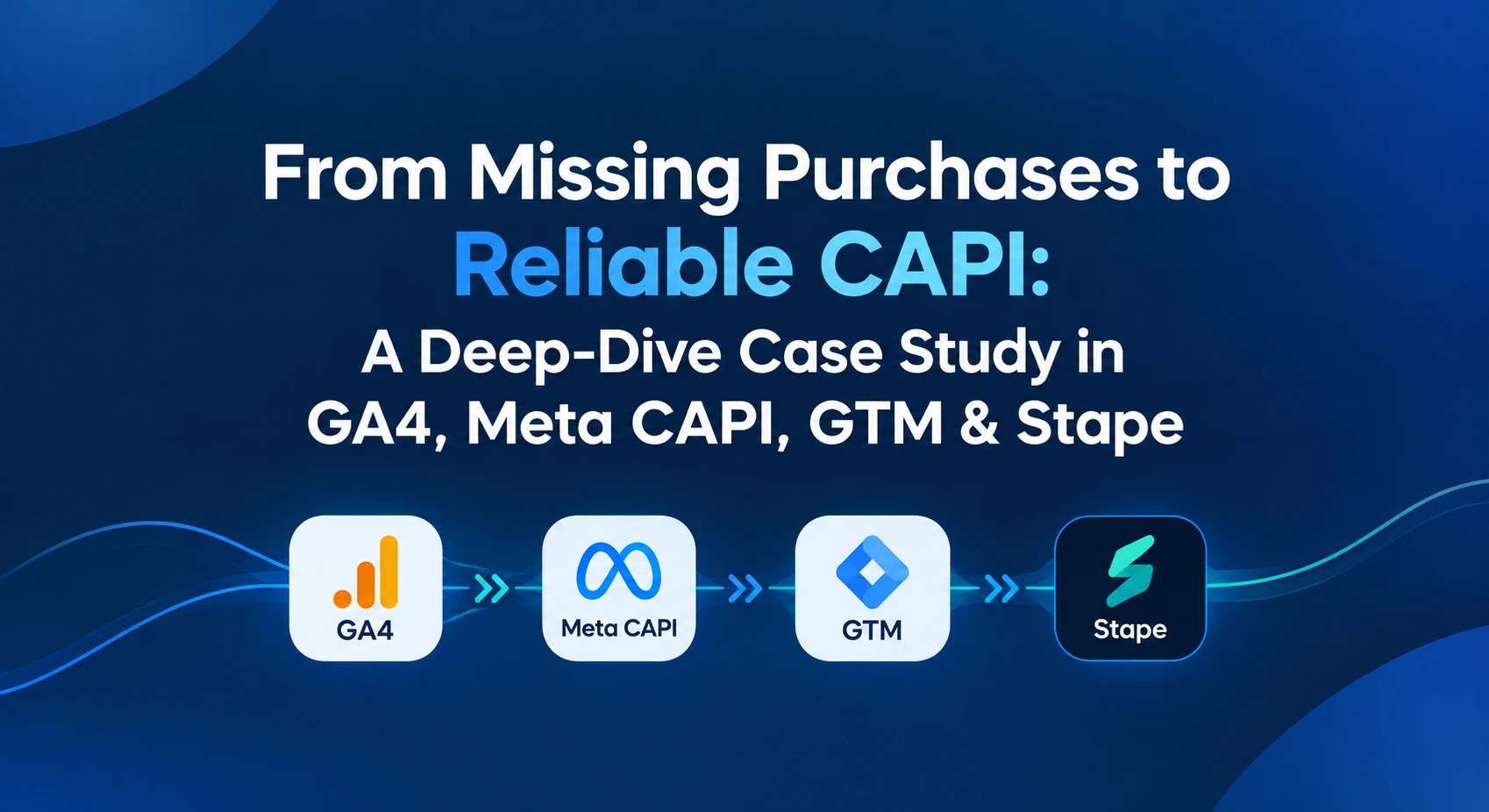
Website → Web GTM → Stape/sGTM → GA4 + Meta CAPI

The investigation eventually revealed that the problem existed upstream of the server-side tracking infrastructure.

For Cash on Delivery orders, the Purchase flow was functioning. For online payments, customers were redirected to the third-party payment processor, SSLCommerz, before returning to the website’s order-success page. On that return journey, the expected Purchase event was not being generated.

At the same time, I discovered a second problem: the website’s dataLayer wasn’t structured well enough for reliable ecommerce and customer-data tracking. Important customer information and ecommerce parameters were missing.

I therefore worked with the developer to restructure the dataLayer using a WordPress/WooCommerce-style structure as a reference. The goal was not to add random fields, but to create an organized structure that included the information the tracking implementation required.

The investigation identified more than seven missing purchases.

The final solution involved correcting the Purchase event flow, improving the dataLayer, exposing ecommerce and customer information, aligning GTM variables with the actual dataLayer structure, and validating the complete event path through GTM and Stape.

One of the most important lessons from the investigation was that a successful API response does not necessarily mean that a conversion event is useful or correctly implemented.
From Missing Purchases to Reliable CAPI A Deep-Dive Case Study in GA4, Meta CAPI, GTM & Stape

1. Project Background

I was working on the website from the beginning of the project as the Digital Marketing Manager, with more than four years of experience across the broader digital marketing and tracking stack, including:

  • Google Tag Manager
  • GA4
  • Meta Pixel and Conversions API
  • Server-side GTM
  • Stape
  • Conversion tracking
  • Marketing analytics

The website used a server-side tracking architecture built around:

Website → Web GTM → Stape/sGTM → GA4 + Meta CAPI

The server-side infrastructure was therefore already in place.

The initial assumption could be that the problem was somewhere inside GTM, Stape, GA4, or Meta.

But I wanted to determine exactly where the data was disappearing.

2. The Initial Problem

The investigation started around September 29, 2026.

I noticed that the website backend and the marketing platforms were reporting different numbers. The backend showed 3 paid orders. These included 2 Cash on Delivery orders and 1 online-payment order. However, GA4 and Meta showed 2 purchases.

The missing order was the online-payment order. This was the first important clue. If all three orders had been missing randomly, I would have investigated the entire Purchase implementation equally. But when I compared the orders individually, a pattern emerged. Cash on Delivery orders were being tracked, while the online-payment order was missing. That immediately narrowed the investigation.

3. My Initial Hypothesis: GTM Purchase Trigger

My first suspicion was the Google Tag Manager Purchase trigger. The Purchase implementation depended on a purchase event. So the first question was: Is the Purchase event actually being generated? This distinction is critical in conversion tracking.

There are several different failure points:

Order completed– does not necessarily mean

Purchase event generated– which does not necessarily mean

GTM processed the event– which does not necessarily mean

Stape received the request– which does not necessarily mean

GA4/Meta received a valid conversion.

I therefore traced the order from the beginning rather than immediately changing the destination-platform configuration.

4. Following the Customer Journey

I manually followed the online-payment customer journey. The flow was:

Customer

↓

Website

↓

Checkout

↓

SSLCommerz / third-party payment processor

↓

Successful payment

↓

Website order-success / thank-you page

At this point, I discovered the critical difference between the two payment methods. For Cash on Delivery, the Purchase tracking flow was functioning. For online payment, the Purchase event was missing after the customer returned from the payment processor.

The Event Checker documentation explicitly separates the two situations into Cash on Delivery Purchase and Online Payment Purchase, and notes that online-payment purchases weren’t being counted because the Purchase event wasn’t firing.

This was the first breakthrough. The backend knew that the order existed. The payment gateway knew that payment had succeeded. But the analytics implementation didn’t necessarily know the order had become a Purchase.

5. Why the Payment Gateway Was Important

The third-party payment flow created a gap in the browser-side tracking journey. The customer left the website to complete payment. After payment, the customer returned to the website. The critical question became: What information is available when the customer returns to the order-success page, and does the website push the Purchase event then?

The answer was no for the problematic online-payment flow. This explained why a real paid order could exist in the website backend while no Purchase request appeared in the tracking pipeline. This was also why simply looking at GA4 or Meta wasn’t enough. Those platforms were downstream. If the browser never generated the appropriate Purchase event, GTM had nothing reliable to send downstream.

6. Moving Upstream: The DataLayer Investigation

Once I understood the Purchase-event problem, I started examining the website’s dataLayer. This revealed a second major issue. The website’s existing dataLayer was limited and, more importantly, was not organized around a consistent ecommerce/customer-data structure.

Important customer information was unavailable in the dataLayer. For example, information required for stronger customer matching included:

  • Email
  • Hashed email
  • Phone
  • Hashed phone
  • First name
  • Last name
  • City
  • State
  • Country
  • ZIP/postcode
  • External ID

The existing implementation did not expose these values in the way the tracking architecture needed. This was important for Meta CAPI because the quality of server-side conversion tracking depends heavily on the quality and availability of the data supplied to it.

7. Why I Recommended a WordPress/WooCommerce-Style DataLayer

I did not want the developer to keep adding individual fields randomly. The existing structure was difficult to work with because fields were inconsistent and important information was missing. So I provided the developer with an example of what a structured WordPress/WooCommerce-style dataLayer could look like.

My reasoning was simple: The dataLayer needed a standard structure, not a collection of unrelated fields.

The WordPress-style structure gave us a logical way to organize:

  • Visitor information
  • Customer information
  • Billing information
  • Shipping information
  • Cart information
  • Order information
  • Product information
  • Ecommerce totals
  • Hashed customer information

The resulting Purchase structure contained an orderData object with order attributes, totals, customer information, shipping information, and product items. For example, the Purchase data eventually contained order attributes such as:

  • Order number
  • Payment method
  • Payment method title
  • Shipping method
  • Order status

along with totals such as:

  • Currency
  • Discount
  • Shipping
  • Subtotal
  • Total

The customer object also contained billing information, hashed identifiers, contact information, and location information. The product information included fields such as:

  • Item ID
  • Item name
  • SKU
  • Price
  • Category
  • Quantity

This was a much more reliable foundation for the tracking implementation.

8. The Relationship Between the DataLayer and GTM

This was one of the most important technical lessons from the investigation. A GTM variable can only retrieve information that exists where it’s looking. For example, my Purchase variables were built around ecommerce parameters such as:

ecommerce.value

ecommerce.transaction_id

But if those fields weren’t present in the dataLayer when the Purchase event fired, GTM couldn’t magically generate them. That created a chain reaction:

Missing dataLayer field

↓

GTM variable returns empty/false

↓

Server-side request contains invalid or missing data

↓

GA4/Meta receives incomplete conversion information

This is why I treated the dataLayer as part of the tracking architecture rather than merely a developer-side implementation detail.

9. Creating a Controlled Test

After identifying the problem, I created a test product and placed test orders. The purpose wasn’t simply to see whether a Purchase appeared. I wanted to identify where the event was failing.

The test had to answer:

  1. Does the website generate the Purchase event?
  2. Does Web GTM receive it?
  3. Does GTM send the request?
  4. Does Stape receive it?
  5. Does Stape forward it?
  6. Does GA4 receive the Purchase?
  7. Does Meta receive the Purchase?
  8. Are the purchase values correct?
  9. Are the customer parameters available?
  10. Is the transaction ID correct?

This transformed the investigation from a reporting problem into an end-to-end debugging exercise.

10. First Successful Test — But Not Yet a Complete Fix

After the developer made the initial dataLayer changes, I created a test order. The Purchase event began reaching the tracking infrastructure. This was a major improvement. However, I did not consider the problem completely solved. Why? Because an event existing is not the same thing as an event being high quality.

The initial corrected test demonstrated that the event could travel through the pipeline, but the data quality still needed improvement. This distinction became particularly important when examining the server-side logs.

11. Using Stape as the Forensic Layer

I used Stape logs to determine whether GTM was sending purchase information correctly to the server-side container. Instead of asking only:

“Why isn’t GA4 showing this purchase?”

I asked: “Did GTM send the purchase?”

Then: “Did Stape receive it?”

Then: “What exactly did Stape receive?”

Then: “What did Stape send to GA4 and Meta?”

This approach allowed me to isolate the failure point. During the investigation, I found that not every purchase event reached Stape. That mattered because it meant the problem wasn’t simply a GA4 or Meta reporting issue. Some conversions were disappearing before they reached the server-side infrastructure.

12. The Second Class of Problem: Invalid Purchase Parameters

During later testing, I found another problem. Some Purchase requests contained values such as:

value = false

transaction_id = false

product_price = false

currency = 0

This was different from the original missing-event problem. Now the event could exist, but the data inside the event could be wrong. The cause became clear when I compared the GTM variables against the actual dataLayer structure. My variables were expecting ecommerce fields such as:

ecommerce.value

ecommerce.transaction_id

But the corresponding fields were missing from the dataLayer implementation. As a result, the GTM variables had nothing valid to retrieve. The result was an event that could technically be sent but contained unusable purchase information.

13. Why an HTTP 200 Response Was Not Enough

This was one of the most important lessons from the project. An API request can succeed technically while the marketing data inside that request is still poor. For example:

HTTP request being successful does not necessarily mean: Correct purchase value, Correct transaction ID, Correct currency, Good customer matching, or Useful conversion data.

This is particularly important with server-side tracking. A CAPI implementation isn’t successful just because the destination API returns a successful response. The actual payload must be inspected.

14. Improving Meta Customer Matching

The original Meta Event Match Quality was approximately: 6.1/10

The website was not exposing enough customer information through the dataLayer. I therefore worked with the developer to make the required customer information available. The implementation eventually made parameters available, including:

  • em
  • ph
  • fn
  • ln
  • ct
  • st
  • country
  • zp
  • external_id
  • fbp
  • client_ip_address
  • client_user_agent

The purpose was not simply to increase the number of fields. Each field had to be available in the right place and pass through the tracking architecture correctly. The broader goal was to improve the quality of the customer information available to Meta for event matching.

15. The DataLayer Became the Foundation of the Solution

The final Purchase structure was substantially more organized. Instead of having isolated ecommerce values, the implementation contained a structured order object. The Purchase data included:

orderData

 ├── attributes

 │    ├── date

 │    ├── order_number

 │    ├── order_key

 │    ├── payment_method

 │    ├── payment_method_title

 │    ├── shipping_method

 │    └── status

 │

 ├── totals

 │    ├── currency

 │    ├── discount_total

 │    ├── shipping_total

 │    ├── subtotal

 │    └── total

 │

 ├── customer

 │    ├── billing

 │    └── shipping

 │

 └── items

      ├── item_id

      ├── item_name

      ├── SKU

      ├── price

      ├── category

      └── quantity

The project documentation shows this structured Purchase object, including customer hashes and product-level information. This structure gave the tracking implementation a much more reliable source of truth.

16. Validation Strategy

I did not validate the fix by checking only GA4. I performed multiple test orders and verified the events at multiple points.

Browser / GTM

I checked whether the Purchase event appeared correctly in GTM.

Stape

I checked whether the request reached the server-side container and inspected the actual parameters being received.

GA4

I verified that the Purchase information was being sent correctly.

Meta

I verified that Meta was receiving the Purchase event and the associated data.

This multi-layer validation was important because a failure at one stage could otherwise be mistaken for a failure at another.

17. Before vs. After

AreaBeforeAfter
Backend ordersMore orders than analytics reportedTracking aligned more closely with completed orders
COD PurchaseWorkingWorking
Online-payment PurchaseMissingPurchase event implemented/validated
DataLayerLimited and inconsistentStructured ecommerce/customer data
Customer informationUnavailable in dataLayerRequired matching information exposed
Transaction IDMissing/invalid in problematic requestsCorrect transaction information available
Purchase valueMissing/false in problematic requestsCorrect purchase value available
CurrencyInvalid/zero in problematic requestsCorrect currency available
Product dataIncompleteStructured product information
StapeSome purchases absentEvents validated through server-side logs
GA4Missing purchasesPurchases appearing correctly
MetaMissing purchasesPurchases appearing correctly
AttributionPotentially incompleteImproved
Event Match Quality6.1/10 initiallyImproved through additional customer data
Debugging processPlatform-level symptomsEnd-to-end request tracing

18. The Most Important Diagnostic Insight

The most valuable part of this investigation was not one particular GTM setting. It was the decision to compare actual backend orders against individual tracking events. When I cross-checked each order against Stape logs, I noticed the missing events weren’t random.

The pattern was:

Paid online orders → missing

while:

Cash on Delivery orders → working

That immediately changed the direction of the investigation. Instead of treating the problem as a generic “GA4 isn’t tracking purchases” issue, I could investigate the specific customer journey associated with the missing order type. That led directly to the payment gateway investigation.

19. What Could Have Happened If We Had Not Fixed It?

This issue could have created several significant problems.

19.1 Underreported conversions

If real purchases weren’t sent to GA4 and Meta, reported conversion volume would be lower than the actual number of orders.

The backend could show the business was generating sales while the marketing platforms showed fewer conversions.

19.2 Incorrect revenue reporting

A Purchase event without the correct value or currency can make revenue reporting inaccurate.

Even when the event exists, incorrect parameters can make the conversion effectively unreliable for analysis.

19.3 Poor advertising optimization

Meta and other advertising systems use conversion signals to understand which users and campaigns are producing results. Missing purchases mean fewer useful signals.

That can affect:

  • campaign optimization
  • audience learning
  • attribution
  • ROAS analysis
  • budget allocation
  • conversion reporting

19.4 Poor customer matching

Without customer identifiers such as email, phone, and other matching parameters, server-side events can have weaker matching quality. The original Event Match Quality of 6.1/10 showed room to improve the quality of the customer information being supplied.

19.5 Incorrect business decisions

This is the biggest risk. Suppose the backend actually generated 100 purchases, but analytics recorded 90 purchases. A marketing manager could incorrectly conclude that campaigns generated fewer conversions than they actually did. That could influence decisions about:

  • campaign budgets
  • audience targeting
  • creative performance
  • product performance
  • channel profitability

In other words, tracking errors can become business decision errors.

20. Why the Fix Was Necessary

The fix was necessary because the problem existed at the foundation of the measurement system. The issue wasn’t simply that Meta needed another parameter. It wasn’t simply that GA4 needed another tag. And it wasn’t simply that Stape needed configuration changes. The fundamental problem was:

The tracking infrastructure didn’t consistently receive the information needed to describe the transaction.

The website backend knew that the order existed. But the measurement architecture needed that transaction to be explicitly represented in the dataLayer and passed through the tracking pipeline. That meant fixing the data source.

21. The Broader CAPI Lesson

A common misconception about server-side tracking is that moving tracking from the browser to a server automatically makes the implementation reliable. It doesn’t. Server-side tracking can improve control, reliability, and data processing, but it still depends on accurate incoming data. The architecture can be represented as:

Website data

↓

DataLayer

↓

Web GTM

↓

Server-side GTM / Stape

↓

GA4 + Meta CAPI

If the information is missing at the beginning, the downstream systems cannot reconstruct it reliably. This investigation reinforced an important principle for me:

Server-side tracking does not eliminate the need for a properly designed client-side data layer.

It makes upstream data quality even more important.

22. My Debugging Methodology

Looking back at the investigation, my approach can be summarized as a sequence:

Step 1 — Start with the business truth

I compared actual backend orders with reported conversions.

Step 2 — Identify the pattern

I noticed that the missing conversions were specifically online-payment orders.

Step 3 — Reproduce the customer journey

I manually followed the online-payment process.

Step 4 — Find the first missing signal

The Purchase event was missing after the online payment flow.

Step 5 — Inspect the data source

I audited the website dataLayer.

Step 6 — Identify missing data

Customer and ecommerce fields were not sufficiently exposed.

Step 7 — Establish a structured data model

I recommended using a WordPress/WooCommerce-style structure as the standard.

Step 8 — Implement and test

I worked with the developer to expose the required data.

Step 9 — Trace the event through the infrastructure

I checked GTM and Stape rather than relying only on destination platforms.

Step 10 — Inspect payload quality

I identified invalid values such as false and 0.

Step 11 — Align variables with the dataLayer

I corrected the underlying data availability so the GTM variables could retrieve the expected values.

Step 12 — Validate repeatedly

I performed multiple test orders and verified the event at both GTM and Stape.

23. What I Learned

The biggest lesson I took from this project was:

A successful HTTP response from Meta doesn’t necessarily mean the event is useful.

A technically successful request can still contain:

  • incorrect revenue
  • missing transaction ID
  • missing currency
  • missing product information
  • insufficient customer information

The same principle applies to the entire tracking stack.

A Purchase event should not be considered “fixed” merely because it appears somewhere in the logs.

I now look at the complete chain:

Did the order happen?

↓

Did the Purchase event fire?

↓

Did GTM receive the correct data?

↓

Did Stape receive the request?

↓

Did the payload contain the correct values?

↓

Did GA4 receive the correct transaction?

↓

Did Meta receive the correct conversion and matching data?

That is a much stronger definition of a successful CAPI implementation.

24. Conclusion

This investigation started with a simple discrepancy: The website backend showed 3 paid orders, while GA4 and Meta showed only 2.

It could have been treated as a routine analytics discrepancy. Instead, I traced the missing order through the entire tracking architecture. The investigation showed the problem was specifically tied to online payments. Customers completed payment through SSLCommerz and returned to the website, but the required Purchase event wasn’t generated reliably.

The investigation then uncovered a second, deeper problem: the website’s dataLayer was limited and did not expose the customer and ecommerce information required for robust tracking.

That led to the development of a more structured dataLayer based on a WordPress/WooCommerce-style model, including order information, totals, customer data, billing and shipping information, product information, and hashed customer identifiers.

More than seven missing purchases were ultimately identified during the investigation. The final implementation was validated using multiple test orders, with the events checked in both GTM and Stape logs and then verified downstream in GA4 and Meta.

The most important lesson is that conversion tracking is an end-to-end system, not a single tag.

A website can successfully process a payment while analytics never receives a Purchase event. A server can successfully send an API request while the payload contains false or incorrect revenue. Meta can return a successful API response while the event still has poor data quality. Therefore, reliable CAPI implementation requires more than configuring an endpoint.

It requires:

accurate business data → structured dataLayer → correct GTM implementation → reliable server-side processing → valid GA4/Meta payloads → continuous validation.

If this issue had remained unfixed, the business would have continued making marketing decisions based on incomplete conversion data. Paid online orders could have remained invisible to GA4 and Meta, revenue could have been underreported, attribution could have been distorted, customer matching could have remained weaker, and advertising platforms would have received fewer reliable conversion signals.

For me, the biggest takeaway is simple:

The quality of a server-side tracking implementation can never be better than the quality of the data it receives.

That is why the dataLayer was not a secondary development task in this project. It was the foundation of the entire measurement system.

How to Run Meta Ads for Branded Products Without Losing Your Ad Account.

How to Run Meta Ads for Branded Products Without Losing Your Ad Account.

Selling real products from big brands like Rolex, Omega, Tudor, Apple, Nike, Adidas, or Louis Vuitton is a normal business. Many stores in Bangladesh and around the world do this every day. You need a different plan to run Meta ads for branded products, as it is not the same as running ads for your own brand.

​Many sellers think one small disclaimer at the bottom of an ad is enough to stay safe. It is not. Meta looks at much more than your caption. It checks your photos, your website, your business details, and whether your ad makes people think you are the brand itself. If Meta is confused about who you are, it can restrict your account.

How to Run Meta Ads for Branded Products Without Losing Your Ad Account.

​This guide breaks down, in plain steps, how you can sell real branded products and lower your risk of ad rejection, account bans, or trademark trouble. As a Meta Ad Expert, I’ve tested these processes and got good results without hampering my clients’ ad accounts. I’ve written down my experience in this blog to make it easy for those willing to run ads themselves.

​Who Should Read This

​This guide is for you if your business does any of these things:

  • You resell real, authentic branded products.
  • You take pre-orders for items from other countries.
  • You import products and sell them locally.
  • You run an independent shop, not an official brand store.
  • You are not a licensed dealer for the brand.

This guide is not for fake, copied, or replica products. Those products break Meta’s rules no matter what you write in the ad.

​

Step 1: Only Sell Real Products

​This is the base of everything else. If you sell fake or replica items, Meta will not let you advertise them, and no strategy in this guide will fix that.

​If your products are genuine, you already have a strong starting point.

​Good examples:

  • A real Omega watch.
  • A genuine Rolex bought from an international supplier.
  • Authentic Nike shoes.

Not allowed:

  • A replica Rolex.
  • A “first copy” watch.
  • A fake designer bag sold as an “AAA” copy.

Step 2: Never Act Like You Are the Brand

​One of the fastest ways to get flagged is making people believe you work directly for the brand.

​Avoid page names and captions like:

  • Official Rolex Dealer
  • Authorized Omega Retailer
  • Official Apple Store
  • Rolex Bangladesh Official

Use wording like this instead:

  • Independent Luxury Watch Retailer
  • Authentic Luxury Watch Pre-Orders
  • Independent Reseller
  • International Sourcing Available

Your page and your ads should always look like they belong to your own shop, not the manufacturer.

​

Step 3: You Are Allowed to Say the Brand Name in Meta Ads

​Many sellers believe that even typing the word “Rolex” or “Omega” breaks Meta’s rules. That is not true. You are allowed to talk about real products by name.

​A good way to say it: “We accept pre-orders for authentic Omega, Tudor, Oris, and Longines watches.” “Message us to check Rolex availability.”

​Risky way to say it: “Official Rolex Store.” “Rolex Bangladesh.” “Authorized Omega Dealer.”

​The rule is simple. Describe the product by name. Do not describe your business as if it is the brand.

​

Step 4: Use Photos You Actually Own to Run Meta Ads for Branded Products

​This step gets skipped the most, and it causes a lot of problems.

​Do not take photos from:

  • The brand’s official website.
  • Brand marketing banners.
  • Brand catalog pages.
  • Official ad campaigns.

Use photos that belong to you:

  • Pictures you took yourself.
  • Photos from your own showroom.
  • Photos of your own stock.
  • Images your supplier permitted you to use.

A disclaimer at the bottom of your ad does not permit you to use someone else’s copyrighted photo.

​

Step 5: Make the Ad About Your Business

​Your ad design should show off your shop, not the brand’s identity.

​For example, an ad layout could look like this:

  • Top right corner: your business logo.
  • Bottom right corner: “Pre-Order Swiss Luxury Watches.”
  • Bottom left corner: “Message Us.”

This tells the viewer clearly that the ad belongs to your business, not the watchmaker.

​

Step 6: Be Careful With Brand Logos

​There is a difference between showing a logo that is naturally printed on the product and using a brand logo as a big design piece in your ad.

​Lower risk: an Omega logo that is visible on the watch dial, because that is just part of the real product.

​Higher risk: placing a large Omega logo right next to your own shop logo in the ad design.

​Safest option: let the product itself be the main visual, without adding extra brand logos around it.

​

Step 7: Write a Simple, Honest Caption

​Your caption should explain what you offer in plain words.

​Example caption: “Pre-Order Alert! We are taking pre-orders for authentic watches from Omega, Tudor, Oris, Longines, Hamilton, Mido, and other Swiss brands. Message us for pricing, availability, and delivery time.”

​Notice what this caption avoids. No fake urgency. No exaggerated claims. No pretending to be an official dealer.

​

Step 8: Add a Short Independent Retailer Note – Don’t Miss This

​A disclaimer will not undo a rule-breaking ad. But it helps show Meta and your customers that you are being upfront.

​Example disclaimer for your website: “SecondBit is an independent luxury watch retailer. We are not affiliated with, endorsed by, or authorized by any brand shown here. All trademarks belong to their owners. We offer authentic watches through our own resale and pre-order service.”

​Put the full version on your website. A shorter version works fine inside the ad itself.

​

Step 9: Make Sure Your Website Matches Your Ad

​Meta does not just check the ad. It also checks where the ad leads. Your landing page should clearly show:

  • Your business name.
  • A way to contact you.
  • Your return policy.
  • Warranty details.
  • How payment works.
  • A statement that your products are authentic.
  • Delivery time estimates.
  • Terms for pre-orders.

If your website looks unclear or unfinished, Meta reviews your ad more strictly.

​

Step 10: Keep Your Ad Design Simple

​People buying luxury products respond better to a clean look.

​A good ad layout has:

  • One clear photo of the product.
  • Your company logo.
  • One offer.
  • One clear call to action.

Avoid:

  • Too many stickers or badges.
  • Flashing discount banners.
  • Extra icons everywhere.
  • Large blocks of promotional text.

A cleaner ad builds more trust than a busy one.

​

Step 11: Pick the Right Campaign Goal

​Luxury buyers rarely buy on the first click. Many want to ask questions before they pay.

​Because of this, message-based campaigns often work better than direct sales campaigns for products like watches.

​Good campaign objectives to pick:

  • Messages
  • Leads
  • Sales, paired with remarketing

A Messenger campaign lets a customer ask about price, availability, delivery time, the reference number, and payment options before deciding to buy.

​

Step 12: Set Up an Automatic Welcome Reply

​When someone messages your page, an automatic first reply saves you time and filters serious buyers from casual ones.

​Example automatic message: “Thanks for contacting SecondBit. Please share the brand, model number, dial color you want, and your budget. We will check availability and send you a price.”

​This speeds up your response time and helps you sort real leads faster.

​

Step 13: Do Not Make Claims You Cannot Prove

Avoid lines like:

  • Cheapest.
  • Lowest Price Guaranteed.
  • Best Deal in Bangladesh.
  • Number One Seller.

Unless you have real proof to back these up, skip them.

Safer wording:

  • Competitive Pricing.
  • Personalized Quote.
  • Trusted Pre-Order Service.
  • Authentic Watches.

Step 14: Keep Your Brand Identity Consistent

Check that these all match and clearly belong to your shop, not the brand:

  • Your Facebook Page name.
  • Your Instagram profile.
  • Your website.
  • Your domain name.
  • Your business name everywhere online.

If your page name looks too close to an official brand page, Meta reviews you more closely, and customers can get confused too.

​

Step 15: Know the Difference Between Meta Rules and Trademark Law

These two things are separate, and mixing them up is confusing.

Meta approving your ad does not mean the brand itself approves of you. A brand owner can still file a trademark complaint if they believe your ad crosses a line, even after Meta approves it.

Following Meta’s ad rules lowers your chance of ad rejection. Respecting trademark and copyright rules lowers your chance of a legal complaint from the brand. You need to think about both, not just one.

Common Mistakes to Avoid

  • Using official product photos instead of your own.
  • Calling yourself an authorized dealer when you are not.
  • Copying text straight from the brand’s website.
  • Making the brand logo the main design element of your ad.
  • Selling replica products.
  • Leaving out basic business information from your website.
  • Making claims you cannot back up.
  • Building a page that looks like an official brand page.

Quick Checklist Before You Launch a Campaign

​

Check that you have

  • Real, authentic products.
  • Photos you own or have permission to use.
  • Ad copy that positions you as an independent seller.
  • Accurate product descriptions.
  • A clear disclaimer.
  • A finished, trustworthy landing page.
  • Matching branding across your page, profile, and website.
  • A Messenger or Lead campaign objective.
  • No exaggerated claims.
  • No wording that suggests an official partnership with the brand.

The Bottom Line

Running Meta ads for Branded Products is possible, and many sellers do it successfully every day. The main idea to remember is transparency. Advertise your own business, not the brand. Describe real products accurately, use photos you have the right to use, and never give the impression that you represent the manufacturer. This approach gives your ad account the best chance to stay active, and it builds real trust with your customers over time.

​

How I Doubled Sales and Search Traffic for a Watch Retailer Alone!!!

Sales and Search Traffic

I am Zakir Hossen Rifat, a professional digital marketer based in Dhaka. I run the full marketing operation for SecondBit, a watch retailer. No team behind me. SEO, social content, YouTube, and paid ads all run through one person. I’ll tell you the way that increased Sales and Traffic for retail business.

Sales and Search Traffic

SecondBit sells watches in a market where buyers still want to walk into a showroom before spending their hard-earned money. That habit does not change because a brand runs ads or ranks on Google.

It changes what the marketing has to do. The goal is not to close the sale online. The goal is to get the right buyer to walk through the door already convinced.

Starting in January 2026, I took over the full strategy for SecondBit. Ad spend stayed small, under 3,000 dollars total, most of it in the first quarter. The bulk of the work went into content and search visibility. Here is what the data shows six months in.

Search visibility

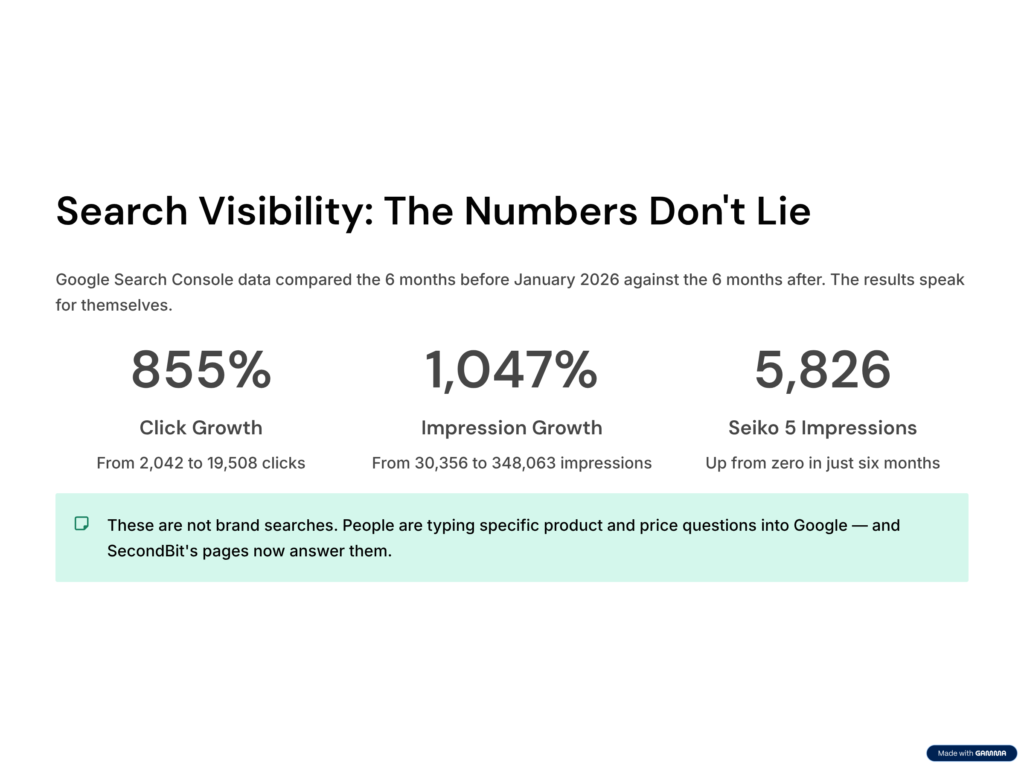
I compared the last 6 months against the 6 months before them, using Google Search Console data for secondbitwatches.com.

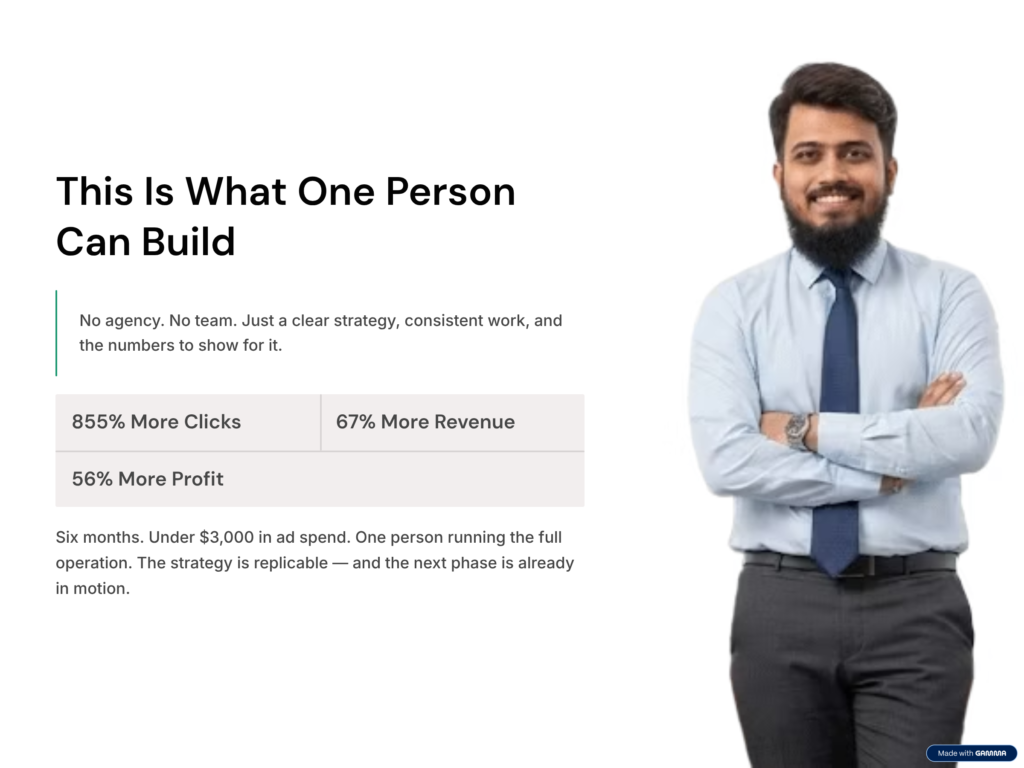
Clicks grew from 2,042 to 19,508, an increase of 855 percent.
Impressions grew from 30,356 to 348,063, an increase of 1,047 percent.

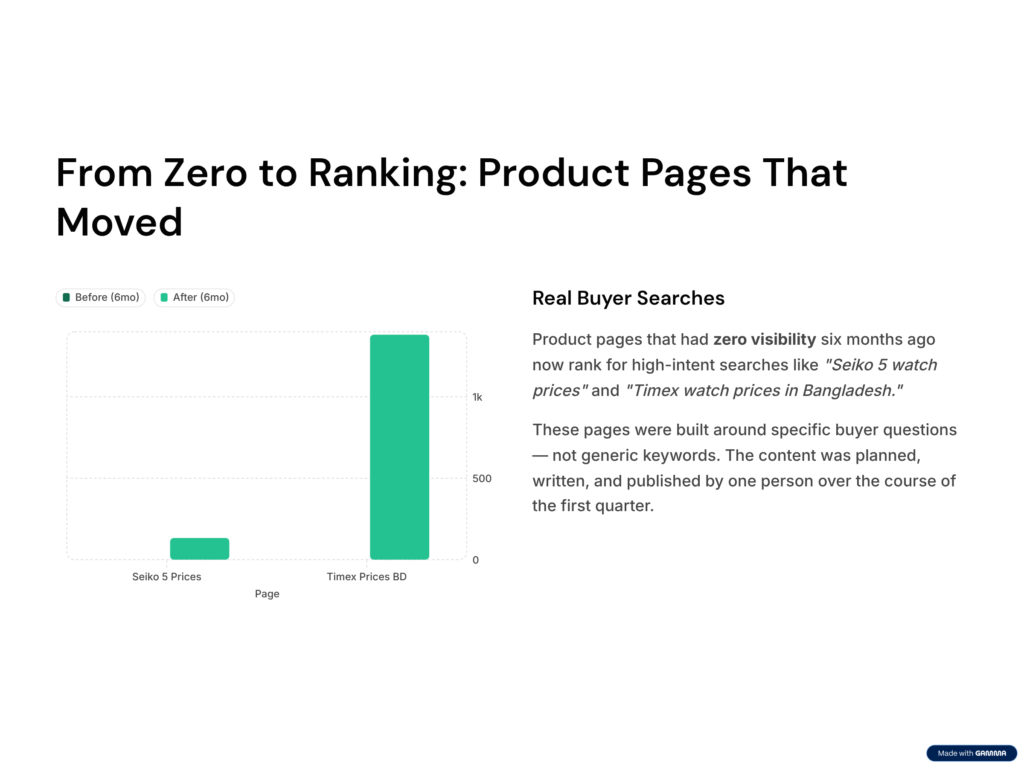
Product pages that had zero visibility six months ago now rank for real buyer searches. The page for Seiko 5 watch prices went from 0 clicks and 0 impressions to 133 clicks and 5,826 impressions. The page for Timex watch prices in Bangladesh moved from nothing to 1,382 impressions.

These are not brand searches. People are typing specific product and price questions into Google, and the pages I built now answer them.

Sales and profit

I compared the second half of 2025 against the first seven months of 2026.

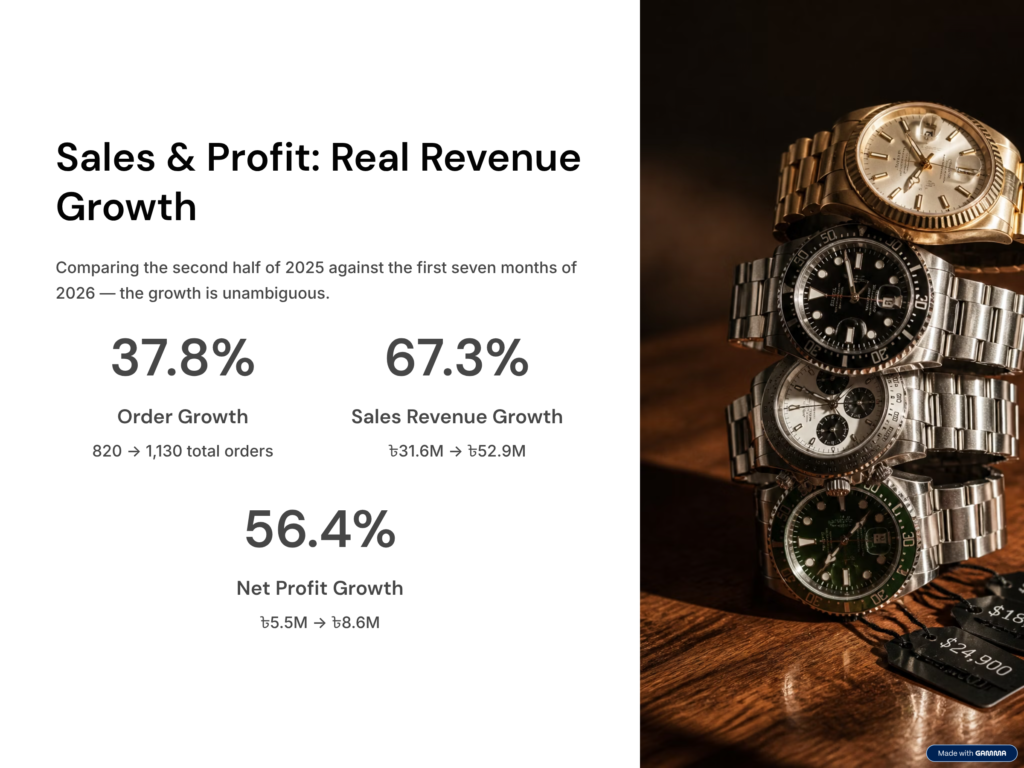
Total orders grew from 820 to 1,130. Up 37.8 percent. Sales amount grew by 67.3 percent. Net profit grew by 56.4 percent.

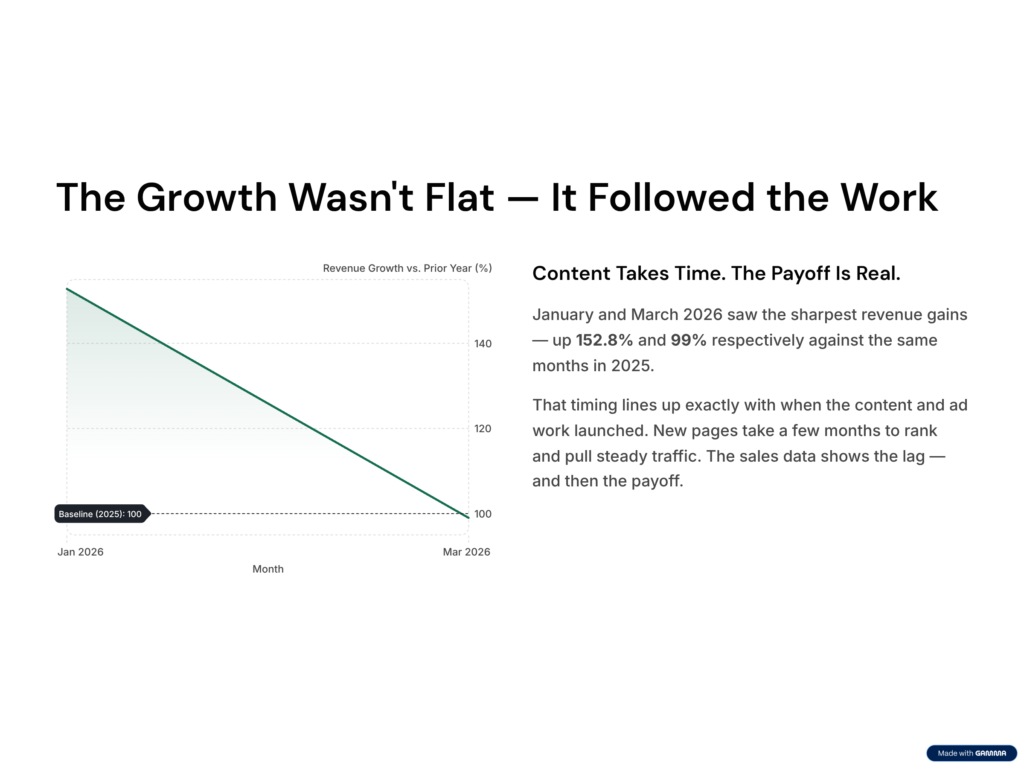
The growth was not flat across every month. January and March 2026 carried the sharpest gains, with grand totals up 152.8 percent and 99 percent against the same months in 2025.

That timing lines up with when I launched the content and ad work. New content takes a few months to rank and pull steady traffic. The sales data shows that lag, then the payoff.

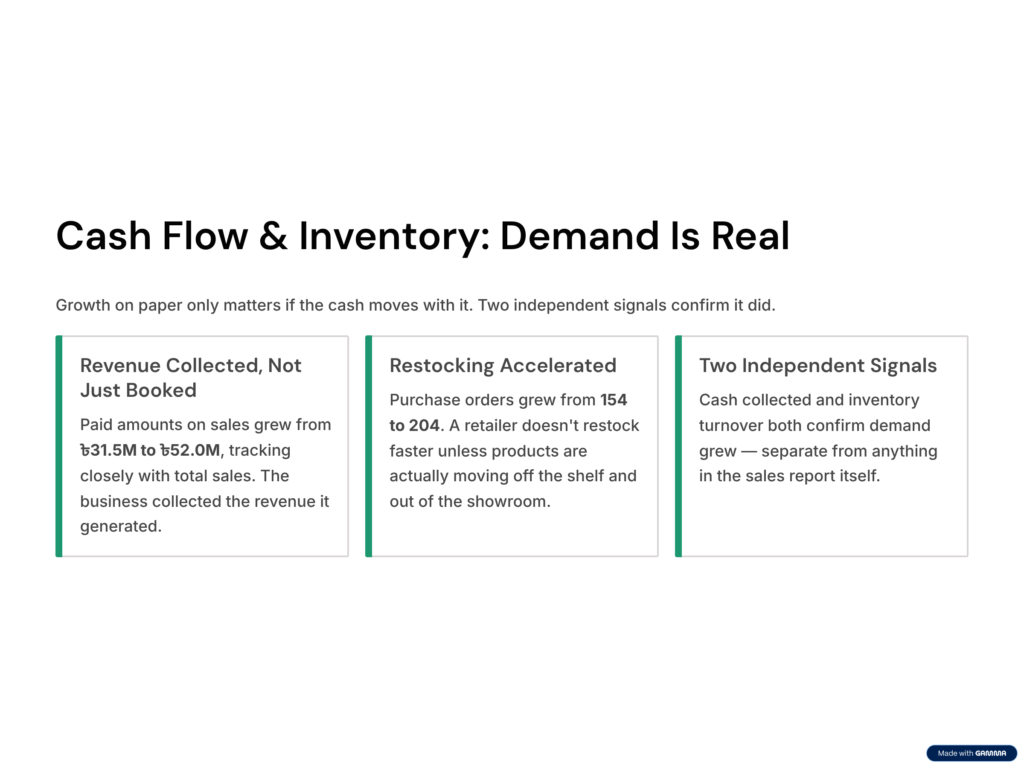
Purchase volume also grew, from 154 restocking orders to 204. A retailer does not restock faster unless products are actually moving off the shelf and out of the showroom. This is a second, independent signal that demand grew, separate from anything in the sales report itself.

What actually worked to increase Sales and Traffic

Three things stand out from the data.

The SEO content targeting specific product categories and price searches did the heaviest lifting. Pages built around real buyer questions, like watch prices in Bangladesh for specific brands, moved from invisible to ranking inside six months. I planned and wrote every one of them.

Paid ads on a small budget supported the early months of growth, but the SEO gains kept building even as ad activity leveled off. That is the sign of a channel with lasting value instead of one that only performs while money is being spent on it.

The showroom model did not slow any of this down. Buyers still research online first. Getting the brand in front of them during that research, through search results and content, is what got them to the store.

What is next to do better in Sales and Traffic

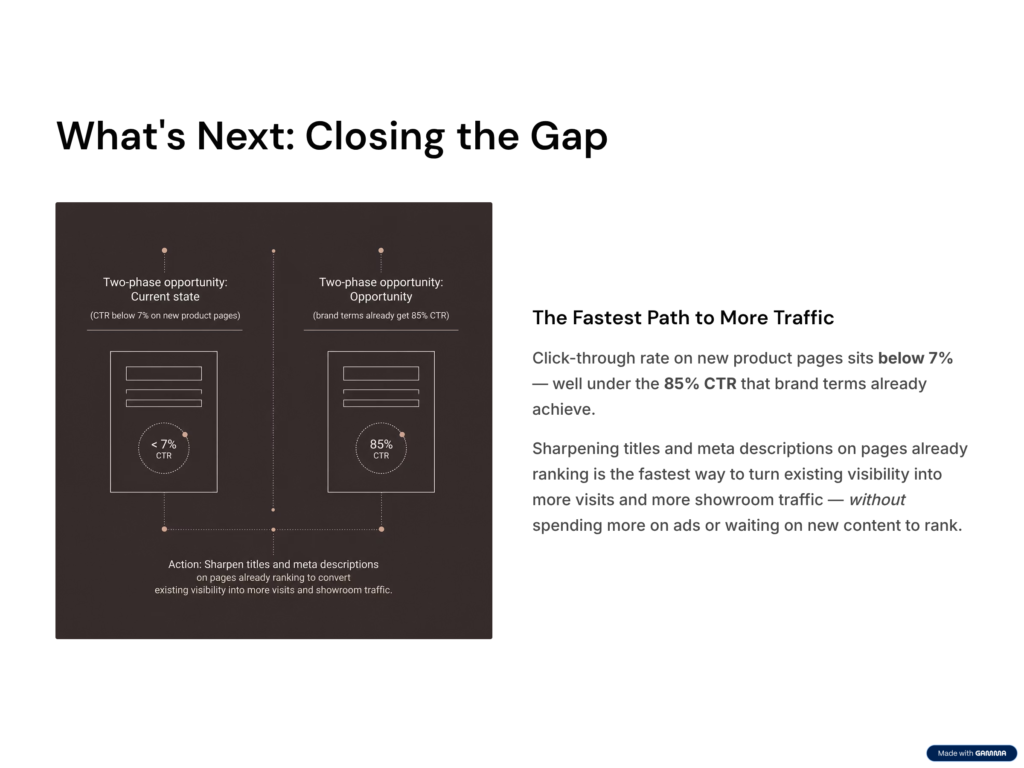
The next phase is closing the gap between impressions and clicks. Click-through rate on the new product pages sits below 7 percent, well under the 85 percent CTR the brand terms already get.

Sharpening titles and meta descriptions on the pages already ranking is the fastest way to turn existing visibility into more visits and more showroom traffic, without spending more on ads or waiting on new content to rank.

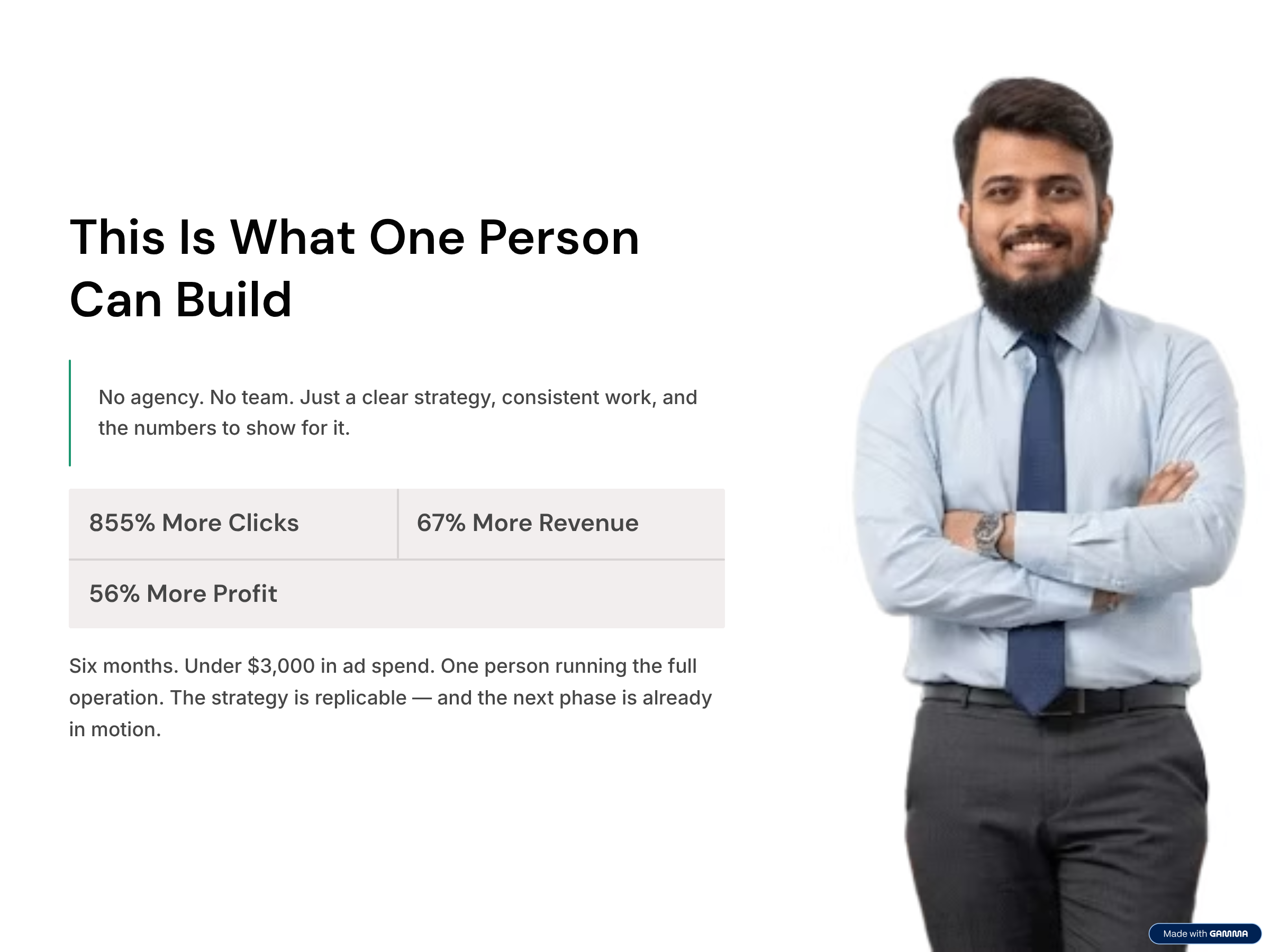
This is what one person can build with a clear strategy and consistent work: no agency, no team, just the numbers to show for it.

​

Buying Behaviour in Bangladesh: The Country Where Everyone Is a Detective Before Buying Anything

If you think Bangladeshi consumers buy products after seeing one Facebook ad, congratulations, you have never sold anything in Bangladesh. Online Shopping Behavior in Bangladesh is less like shopping and more like conducting a criminal investigation.

A typical buyer will:

  •  See the product on Facebook
  •  Check the price on 7 different pages
  •  Ask 3 friends
  •  Ask one cousin who lives abroad, because apparently, he knows everything
  •  Read comments from random people named “MD Sumon Official”
  •  Check if Cash on Delivery is available
  • Then maybe buy it
  • Then tell 15 other people whether it was good or bad

Welcome to the Bangladeshi buying journey.

Discovery: Facebook Is the Shopping Mall, the Newspaper, and the Marketplace

In many countries, people discover products through Google. In Bangladesh? Facebook is basically the unofficial Ministry of Commerce.

Around 60 million Bangladeshis use Facebook. Many businesses don’t even bother building a website. Why spend money on a website when customers are already living inside Facebook?

A typical seller’s business model:

  • Create a Facebook page
  • Post product photos
  • Wait for inbox messages
  • Negotiate price in Messenger
  • Arrange delivery
  • Repeat until Eid season arrives and chaos begins

This is why social commerce is huge here. People like talking before buying. The chat itself becomes part of the shopping experience.

Price: The National Hobby in Online Shopping Behavior in Bangladesh

If there were an Olympic event for comparing prices, Bangladesh would send a gold-medal team every year.

Research shows 79% of Bangladeshis shop online mainly because prices are lower.

But “lower” is not enough.

The buyer wants:

  • Lower than Daraz
  • Lower than the local shop
  • Lower than the cousin’s recommendation
  • Lower than yesterday’s price
  • Preferably lower than what his friend paid six months ago

A Bangladeshi buyer rarely sees one price and says, “Sounds good.” That sentence almost doesn’t exist in the market.

Price checking is not optional in Online Shopping Behavior in Bangladesh. It’s a cultural ritual.

Online Shopping Behavior in Bangladesh

Trust: Because Bangladesh Has Been Through Some Things

Here’s the biggest reason online shopping grows slower than social media use:

People remember the e-commerce disasters.

A few years ago, several platforms collected money, failed to deliver products, and disappeared faster than your mobile balance after buying internet data.

As a result, many buyers think:

“Brother, product first, money later.”

That’s why Cash on Delivery remains king. It’s not just a payment method. It’s a trust test.

The customer is basically saying:

“I’ll believe you when the delivery guy is standing at my door.”

Harsh? Yes. Understandable? Also yes.

Family Influence: Ads Are Cute, But Mom Has the Final Vote

One of the most unique facts of Online Shopping Behavior in Bangladesh is family influence. Studies consistently show that friends and family influence buying decisions more than advertisements. Think about it.

You spend 50,000 taka on Facebook ads.

The customer’s mother says:

“This brand isn’t good. Your uncle bought one and had problems.”

Congratulations, your marketing budget just lost a fight to one family conversation.

In Bangladesh, buying decisions often involve:

  • Parents
  • Spouse
  • Siblings
  • Relatives
  • Friends
  • Sometimes the entire neighbourhood committee, if it’s a wedding, purchases.

The customer is rarely buying alone. The customer is buying with a committee.

Eid Season: When Budget Plans Go on Vacation

During normal months, people compare every taka.

During Eid? Different story.

Suddenly, the same person who spent two hours comparing prices says:

“Give me the premium one.”

Because Eid shopping isn’t only about need.

It’s about:

  • Family expectations
  • Social status
  • Looking good in photos
  • Meeting relatives who haven’t seen you all year
  • Avoiding the sentence: “This year’s outfit looks a bit simple.”

Online Shopping Behavior and Online sales often change dramatically during Ramadan and Eid periods. For many businesses, Eid is not a season. It’s the survival mode of the year.

Dhaka vs Rural Bangladesh: Two Different Universes

Online Shopping Behavior in Bangladesh varies from place to place. Behavior may change in two different places in a same country.

A Dhaka customer might:

  • Watch reviews on YouTube
  • Compare prices online
  • Order through an app
  • Pay with mobile banking

A rural customer might:

  • Ask the local shopkeeper
  • Buy from someone he already knows
  • Purchase on informal credit
  • Value relationship over convenience

Same country, completely different buying environment.

That’s why one marketing strategy rarely works everywhere.

The Actual Online Shopping Behavior in Bangladesh

Let’s be honest about how it usually happens.

Step 1: See the product on Facebook or TikTok

“Hmm, looks interesting.”

Step 2: Check Price

“Why is this page selling it for 500 taka more? Are they adding gold plating?”

Step 3: Ask Friends

“Anyone used this brand?”

Step 4: Read Comments

Even the comments saying “Inbox me” somehow get analysed.

Step 5: Trust Check

“Do they have a real address? A phone number? Do they reply to messages? Have they posted in the last three months?”

Step 6: Payment Check

“Cash on Delivery available?”

This question has saved many Bangladeshi consumers from many headaches.

Step 7: Final Consultation

“What do you think? Should I buy it?”

Step 8: Purchase

Finally.

Step 9: Become the New Reviewer

Now the buyer tells everyone else whether the seller was good or terrible. The cycle continues.

The Real Formula for Selling in Bangladesh

Many brands think they need fancy marketing funnels. Bangladesh’s market often responds to a simpler formula:

Visibility + Competitive Price + Trust + Social Proof = Sales

Remove visibility, people never see you. Remove competitive pricing, people compare and leave. Remove trust, people choose Cash on Delivery or avoid you completely. Remove social proof, people ask someone else for a recommendation. All four matter.

Conclusion

Bangladeshi consumers are not impulsive buyers. They are cautious buyers who become emotional buyers during festivals.

They use Facebook like a marketplace, family like a review website, and Cash on Delivery like an insurance policy.

A marketer who ignores price loses attention. A marketer who ignores trust loses the sale. A marketer who ignores word of mouth loses the market.

And if your customer says “I’ll ask my friend first,” don’t panic. That’s not a rejection. That’s Bangladesh’s version of the checkout process.

Honestly, if Bangladesh ever launches a national sport called “Comparing Prices Before Buying,” half the population already has professional-level experience.

The other half is still checking one more Facebook page before making a decision.

Digital Marketing in Bangladesh: Beginner’s Guide 2026

Digital Marketing in Bangladesh

Marketing of products or businesses is different nowadays than it was 10 years ago. Previously, companies used radio, television, billboards, and newspapers to reach customers. The majority of the modern population spends a significant portion of the day online. Nowadays, companies are taking digital marketing in Bangladesh seriously to access their market through the internet, due to this digital shift.

Big businesses and small stores are all attempting to establish an online presence. Social media, search engines, and websites have become the core instruments of businesses. It seems like, if you are invisible online, hardly anyone knows you. As a result, people lose a ton of customers every day.

With this guide, you will know everything about digital marketing in easy terms. Before diving into the key concepts, let’s clarify what digital marketing truly means, what it entails, what digital marketers do, what tools they work with, and whether it is a good career choice in Bangladesh.

​

Digital Marketing in Bangladesh

What is Digital Marketing?

Digital marketing refers to marketing products or services through the internet. Companies utilize the Internet to reach their prospective clients and influence them to purchase their products or services.

Companies are advertising on search engines, social media platforms, websites, mobile apps, and email rather than advertising in newspapers or on TV.

If you search for a product on Google and an ad appears at the top of the list, then that is digital marketing. If you see a sponsored post on Facebook or Instagram, that is digital marketing as well.

In summary, digital marketing refers to the act of marketing businesses on the internet. Next, let’s explore some fundamental aspects of digital marketing to understand its full scope.

​

What Digital Marketing Is All About?

Online marketing does not only involve placing advertisements. It is also the relationships with customers and assisting them or guiding them to the correct product or service.

The main pros of digital platforms are that you can not only promote your business but also interact with your customers, which is not possible in traditional marketing. Billboards/ Newspapers can not communicate with you, but your social profile can. You can easily see what your audience wants, what their point of view is.

The primary objectives of digital marketing are:

  • Increasing brand awareness
  • Generating traffic to the site.
  • Generating leads
  • Increasing sales
  • building customer trust

An effective online marketing plan involves blending various techniques to reach people at the appropriate time with the appropriate approach.

As a reference, a clothing shop in Dhaka can use social media like Facebook or Instagram to present new designs, advertise in order to attract new clients, and resort to email marketing to notify shoppers about discounts.

​

What does Digital Marketing Include?

Digital marketing is a broad concept. It is a combination of various marketing procedures that operate simultaneously.

Now we can discuss the key forms of digital marketing.

​

Search Engine Optimization (SEO)

Search Engine Optimization, also referred to as SEO, is the act of enhancing a site to appear higher or on the first page of Google search results or SERP.

Seo

When a person goes to Google searching for a product or service, he/she tends to visit one of the first results he/she meets. SEO assists companies in ranking at the top position on the first page of Google search results.

SEO involves tasks such as:

  • Keyword research
  • Improving website content
  • Optimizing page speed
  • Building backlinks
  • Improving user experience

As an example, when an individual types best restaurants in Dhaka, then the restaurants that have excellent search engine optimization stand a higher chance of ranking in the search list.

​

Social Media Marketing

Social media marketing entails advertising on the following platforms:

  • Facebook
  • Instagram
  • YouTube
  • LinkedIn
  • TikTok
social media marketing

Businesses make interesting posts, they post videos, and communicate with their followers, and this way they create a community of loyal followers.

The bakery in Bangladesh could be used as an example, where they could use Instagram to place pictures of fresh cakes to engage the customers.

Social media marketing is also associated with paid advertisements, which enable businesses to target certain audiences.

​

Content Marketing

Content marketing is a strategy centered on producing helpful and useful content that is appealing and informative to individuals.

Content can include:

  • Blog posts
  • Videos
  • Infographics
  • Guides
  • Tutorials

Quality content can assist companies in gaining the trust of the readers. And it is the psychological fact that brands that give the audience information, they will prefer to use that brand.

​

Email Marketing

One of the oldest forms of digital marketing is email marketing, yet it is very effective.

Companies are emailing their clients the following:

  • Promotions
  • News
  • Product updates
  • Special offers

An online store can, for example, email a discount on a holiday.

Email marketing assists companies in remaining in touch with their clients.

​

Pay-Per-Click Advertising (PPC).

Pay-Per-Click advertisement implies that a business pays each time a person clicks its advertisement.

Pay per click marketing

These ads often appear on:

  • Google search results
  • YouTube videos
  • Facebook feeds
  • Instagram stories

PPC campaigns enable companies to access their target audience within a short period of time.

​

Affiliate Marketing

Affiliate marketing is where one advertises the products and gets a commission every time they sell for the company.

Affiliate marketing is a common way of making money online for bloggers, influencers, and content creators.

​

Which Digital Marketing Tools Are in Use?

There are tools that digital marketers regularly use to control campaigns, perform performance analysis, and enhance performance.

Digital marketing tools

For digital marketing in bangladesh various tool are used:

Google Analytics

The tool assists businesses in analyzing the interaction between visitors and their site.

It shows data such as:

  • Number of visitors
  • Traffic sources
  • User behavior

​

Google Ads

Google Ads gives companies the opportunity to advertise on Google search engines and other websites.

It is also among the strongest online advertisement platforms.

​

Meta Ads Manager

This is the tool that is utilized to have advertisements on Facebook and Instagram.

Businesses can reach certain audiences based on:

  • Location
  • Interests
  • Behavior
  • Age group

​

SEMrush and Ahrefs

The tools assist marketers in doing keyword research and analysing the performance of websites.

These are usually applied to SEO and competitor research.

​

Canva

Canva is used to generate attractive graphics in social media posts, advertisements, and presentations.

This tool allows even amateurs to create professional images.

​

HubSpot

HubSpot is a well-known marketing tool that assists companies in dealing with leads, email marketing, and customer relationships.

​

What do digital marketing professionals do?

Online marketers are significant in ensuring the success of a business in the online world.

Let us see what the typical roles of digital marketing are.

​

The role of a Digital Marketing Specialist.

Planning and management of the online marketing campaigns is the responsibility of a digital marketing specialist.

They have primary duties of:

  • Developing marketing programs.
  • Managing social media pages
  • Conducing advertising campaigns.
  • Campaign performance analysis.
  • Improving website traffic

They collaborate with the owners of the businesses to assist in attaining marketing objectives.

​

The role of a Digital Marketing Executive.

A digital marketing executive tends to coordinate the day-to-day marketing activities.

They are usually responsible for:

  • Sharing content on social media.
  • Carrying out keyword research.
  • Following up on campaign performance.
  • Making marketing reports.

This position is usually the beginning of most digital marketing careers in Bangladesh.

​

What Digital Marketing Skills Does it Require?

In order to be effective in digital marketing in Bangladesh, a professional must have both technical and creative skills.

There are such critical digital marketing skills as:

  • Search Engine Optimization
  • Social media marketing
  • Paid advertising management.
  • Content writing
  • Copywriting
  • Data analysis
  • Marketing strategy

The ability to learn these skills can lead to numerous career opportunities.

​

What Does a Digital Marketing Agency Do?

A digital marketing agency is a firm that offers services that assist companies in expanding online. Numerous companies seek the help of digital marketing companies to do their online marketing.

These services may include:

  • SEO optimization
  • Social media management
  • Paid advertising campaigns
  • Website marketing
  • Content creation

Agencies have various clients and sectors, which they assist in enhancing their online presence.

Digital marketing agency

A digital marketing firm aims to improve the visibility of a brand and make it appealing to customers via digital platforms. There are multiple agencies available for digital marketing in Bangladesh.

They aim to support businesses:

  • Increase website traffic
  • Generate leads
  • Boost online sales
  • Improve brand recognition
  • Firms tend to develop long-term marketing plans for their customers.

Website Characteristics of the Digital Marketing Agency.

The typical elements of a professional digital marketing agency website are:

service pages stating what they offer.

  • A collection of previous work.
  • Client testimonials,
  • Contact information,
  • Marketing-related blog articles.

These aspects assist in developing confidence among the prospective customers. Day by day agencies are becoming important for business owners because it is tough to maintain all digital marketing aspects at the same time.

​

Context of Digital Marketing in Bangladesh.

Digital marketing is evolving at a high pace in Bangladesh. Digital marketing in Bangladesh has now become an essential aspect for any business.

The use of the internet has gained momentum in the last couple of years. Millions of individuals are using smartphones and social media on a daily basis.

This expansion has presented gigantic business opportunities.

​

The Reason Why Companies in Bangladesh Should Digitalize Marketing.

Digital marketing is relevant to business in Bangladesh due to a number of reasons.

Increasing Internet Users

The number of people who are linked to the internet is increasing. This renders online marketing highly effective.

Growth of E-Commerce

There is an increase in online shopping. Most of the businesses are selling products via websites and social media.

Social Media Popularity

Facebook and YouTube have several million users in Bangladesh.

These platforms enable businesses to reach potential customers easily.

​

Online Marketing Degree and Track

A high number of individuals in Bangladesh are interested in learning digital marketing since it provides them with good career opportunities.

​

The components of a Digital Marketing Course.

The average digital marketing course includes the discussion of the following topics:

  • SEO fundamentals
  • Social media marketing
  • Google Ads
  • Facebook advertising
  • Content marketing
  • Analytics and reporting

The courses impart theoretical and practical skills.

​

Digital Marketing in Bangladesh: A to Z Learning Path.

In case you wish to study the basics of digital marketing, this is the path you can take.

Step 1: Learn Marketing Basics

Know how marketing functions and why companies must have it.

Step 2: Learn Website and SEO

Understand the way websites work and how to optimize them for search engines.

Step 3: Master Social Media Marketing.

Training in the creation of interesting posts and the management of social media pages.

Step 4: Learn Paid Advertising

Know how to conduct advertisement campaigns on Google and social media.

Step 5: Learn Analytics

Assess the performance by studying marketing data.

​

List of Digital Marketing Skills.

The following are some of the most critical skills that digital marketers ought to acquire:

  • Keyword research
  • Search engine optimization
  • Social media strategy
  • Management of advertising campaigns.
  • Content writing
  • Marketing analytics
  • Conversion optimization

The skills assist marketers in developing successful online campaigns.

​

Digital Marketing: Is it a Good Career in Bangladesh?

The question that most individuals tend to pose is whether digital marketing is a career worth pursuing. The answer is yes. One of the rapidly developing industries in Bangladesh is digital marketing.

​

Digital Marketing as a Career.

This is an appealing career due to several reasons. Some of them are

High Demand

Companies require competent online marketers to handle their presence online.  Increased recruitment of digital marketers or digital marketing experts in Bangladesh over the last few years is proof of the high demand for it.

Freelancing Opportunities

There are several professionals who operate freelance and offer their services to consumers across the globe.

Remote Work

Digital marketing enables one to work at home or anywhere as long as one has access to the internet.

​

Digital Marketing Is Future-Proof.

The need for digital marketing will increase. With the increasing number of businesses going online, they will require professionals who will assist them in accessing their customers online. This renders digital marketing a good career choice in the future. Even if you notice the growing aspect of Digital Marketing in Bangladesh, it is definite that the job sector will boom day by day in Bangladesh.

​

Is Digital Marketing Simple or Complex?

Digital marketing can be quickly learned, and it is mastered with time and practice. Its rudimentary ideas are mere. The basics can be learnt by anyone. Nevertheless, to be a specialist, one has to:

  • Continuous learning
  • Testing alternative strategies.
  • Analyzing marketing data

Just as with any talent, one improves with experience.

​

Is Digital Marketing Worth It?

Digital marketing is worth studying, yes. It is useful in a variety of ways, such as:

  • Freelancing income
  • The capability of being a business owner.
  • Chances of dealing with international clients.
  • Good working prospects

Digital marketing is a promising profession with hard work and training.

​

Frequently Asked Questions

What is Digital Marketing?

Digital marketing refers to the act of marketing goods or services using the internet via search engines, social networks, websites, and email.

​

What is the work of Digital Marketing?

Digital marketing assists companies in capturing customers, creating brand recognition, and making sales through the use of internet-based marketing.

​

Which Digital Marketing tools are utilized?

The most popular ones are Google Analytics, Google Ads, Meta Ads Manager, SEMrush, Ahrefs, Canva, and HubSpot.

​

What does Digital Marketing need?

Such skills as SEO, social media marketing, content writing, paid advertising management, and data analysis are important.

​

Is it a good career to be a Digital Marketer?

Yes. Digital marketing provides good employment opportunities, freelance opportunities, and career development.

​

Conclusion

Digital marketing has become very crucial for businesses nowadays. Internet and Social media users have increased so much that businesses are taking online marketing very seriously. Digital marketing in Bangladesh is getting noticed more than ever.

Digital marketing has many aspects, such as SEO and social media marketing, paid advertising, and content creation, which can assist businesses in their development. If anyone is looking for the answers for “is digital marketing in bangladesh is worthy, is digital marketing in Bangladesh future-proof, is digital marketing in bangladesh will be right choice for a career?” Then “YES”, it is the best possible future-proof and most demanding job for businesses in the modern era.

Meta Andromeda Update: What It Really Means for Your Facebook and Instagram Ads in 2025–2026

Meta Andromeda Update

Sometimes, digital advertising changes so rapidly that we can not keep up with it. One day, you are playing with interests and demographics like an expert, and the following day, everything changes. It was precisely what occurred with the recent massive action of Meta, the “Meta Andromeda Update”.

You need to pay attention to this in case you place advertisements on Facebook or Instagram, particularly in this country, Bangladesh. It is silently transforming the manner in which advertisements are displayed, to whom, and their effectiveness. The reason why the old ad strategy will not work well is due to the recent launch of the Meta Andromeda Update.

In this informative blog post, I will take you through the whole in simple, related terms:

  • What is the Meta Andromeda Update really?
  • How does the new system work?
  • When it rolled out?
  • How does it change targeting?
  • What step should you takeke to run facebook ads in 2026?

And the most important thing, what you are supposed to do next, in case you are advertising outside of Bangladesh.

Let us deep dive into it.

What Is the Meta Andromeda Update?

In simple terms, you can call Andromeda a matchmaker, who connects your ad to the most relevant and potential audience or customer. In the Meta ecosystem, Andromeda is the new AI-powered matchmaker. It applies intelligent AI to choose the ad that will appear to each user scrolling through Facebook or Instagram.

We used to do much of the work by ourselves before, selecting the exact ages, locations, interests, and behaviours. But the new system that Meta has now developed is looking at the real-life behavior of people on the internet and identifying the most likely people to click, message, or purchase by default.

It presents the correct ad to the correct person at the correct time, without your having to watch over every minute detail. It makes the work of an ad specialist easy for everyone.

In short, Meta Andromeda Update is an intent-based AI-powered update, where Meta itself chooses who to show your ad with the highest accuracy and relevancy.

What did Meta introduce with this Update?

Meta desired advertising to be more natural and helpful to all. This is what they really wanted:

Better performance: Ads are being shown to people who are interested in them. It ensures better results, link clicks, and sales.

Smart Learning: This system continues to learn your ad and your ideal audience, and advances automatically. You don’t need to change settings on a weekly basis.

Better user experience: Your ad will reach your potential customers rather than random people. With accuracy, people will not scroll past your ad.

What Are Its Affected Platforms?

Andromeda affected almost everything in the Meta umbrella:

  • Facebook Ads
  • Instagram Ads
  • Meta Ads Manager
  • Advantage+ campaigns

Andromeda is already doing the background work on you in case you happen to be running one of these.

A Brief Timeline Meta Andromeda Update

The transformation to Meta Andromeda didn’t happen overnight. It advances its system step by step so that the expected result can be made.

First, Meta began to entrust AI automation with more power in 2025. Advertisers realized that allowing the system to select wider audiences was more effective than hyper-narrow targeting.

By 2026, things got even better. The AI is now analyzing the way people interact with the content, their purchase journey, and how they interact, and the delivery of ads feels almost personal.

The Metamorphosis of Meta Ads at Andromeda

Meta Andromeda Update changes everything. The biggest shift? Now, most of the heavy lifting in the decisions in the ad campaign is done by the AI.

The following is what that would look like in practice:

Quick and clever delivery: It reads billions of signals (what you look at, what you liked on the previous site, what you have purchased) and chooses the most suitable one in a fraction of a second.

Meta Andromeda Update

Enhanced ad ranking: Rather than making guesses, it forecasts the people most likely to take action, like adding something to the cart or completing a lead form.

Concentrate on actual conversions: In case you want to sell or get leads, the system will give priority to individuals who appear to be willing to do so.

The Implication of this to Audience Targeting

This is what is new to the majority of us.

There is no longer a need to spend hours developing detailed lists of interest. Broad targeting tends to be winning today as the AI does the detective work, which is to identify people who behave like your best customers, even though they would not have had the exact interests that you would have selected.

Meta Andromeda Update

The system is continuously discovering new potential buyers for you.

Bangladesh Special Advertisement Notice

It is actually quite good news in case you are running ads here in Bangladesh, whether for a clothing brand in Dhaka, a food delivery service in Chittagong, or a small startup.

After the Meta Andromeda update, with smaller budgets, it has become possible to compete more fairly. The AI is now updated to Meta Andromeda and will learn how people in this area shop, scroll, and their purchasing behavior.

This will ensure your advertisements are displayed to the appropriate audience without any in-depth configurations. With less complex campaigns, a lot of local companies are achieving better outcomes than they ever had.

Old Algorithm vs Andromeda: Side-by-side

Before:

  • Heavy manual targeting
  • Constant tweaking needed
  • Slower learning curve

Now with Andromeda:

  • The optimisation is mostly done by AI.
  • Wider audiences tend to perform better.
  • The longer campaigns run, the smarter they become.
Meta Andromeda Update

What’s better now

  • Increased performance and conversion rates.
  • Reduced time on tedious configuration.
  • More convenient finding of new customers.

What feels different

  • Weaknesses in super-specific targeting.
  • Your advertisement designers are more than ever.
  • You actually require good conversion tracking.

It is a massive opportunity for Bangladeshi businesses, particularly for local brands and startups. They can now reach their ideal customers easily despite having small budgets.

How to refresh your strategy in the Post-Andromeda Era

For running Facebook ads in 2026, you don’t need to start from scratch.  Just make a few smart shifts:

Make creatives the priority: Stunning pictures, mini-videos, and concise messages are now winning big. Try out various styles.

Attempt Advantage+ campaigns: These are designed to run on the new system and are usually the most successful.

Meta Andromeda Update

Don’t narrow down your targeting: Let the AI work, and never narrow down your audience with targeting.

Keep it simple and clear goals: Select purchases, leads, or sign-ups in such a way that the system can be sure of what to optimise.

Best Practices to Achieve Great Results

All you need to do to achieve great results on Facebook or Meta Ads right now is

  • Ensure that your Meta Pixel has been installed and is functioning well.
  • Use at least 5-10 creatives per campaign. Some advertised advice to start with 20 creatives. But if it is tough for you, then at least start with 4/5 creative.
  • Allow the AI to learn (do not interrupt it too frequently)
  • Verify performance on a regular basis; however, believe in the system.

Do this, and you will see the algorithm turn into your new useful companion rather than a riddle.

The Future of Meta Advertising

Meta is undoubtedly committing to AI. Meta Andromeda Update is the beginning o.f it. There will be more automation, improved prediction, and easier-to-use tools in the future months and years, which will benefit advertisers.

In our case in Bangladesh, it translates to spending less time on technicalities and reaching more potential customers based on their intent.

Frequently Asked Questions

Just what is the Meta Andromeda Update?

It is a new AI-powered system of Meta that chooses the ads to display to people based on actual behaviour rather than a set of rules.

When did it come out?

It was implemented slowly, beginning in 2025, and became more prominent by 2026.

Is it good for advertisers?

Yes. The majority of people are getting better results when they change their strategy. The trick lies in powerful creatives and AI doing the work.

Should I transform everything?

Not all. Only pay more attention to creative diversity, targeting expansion, and conversion objectives.

Final Thoughts

Meta Andromeda Update initially seems like a major change, but in the long-term perspective, it makes advertising easier and more efficient.

You can no longer struggle to bend the system to your endless tweaks, but rather work with it, create great ads, and have Meta smart technology identify the right people.

If you are a Bangladeshi advertiser, this will be your opportunity to reach more customers at a relatively low cost. Try the new approach, continue testing, and see what happens.

Have questions about your own campaigns? Get them into the comments. I like to chat!

To improve advertisements and performance in 2026 and beyond.